Ferdousi Islam, MA in Art History and MLIS
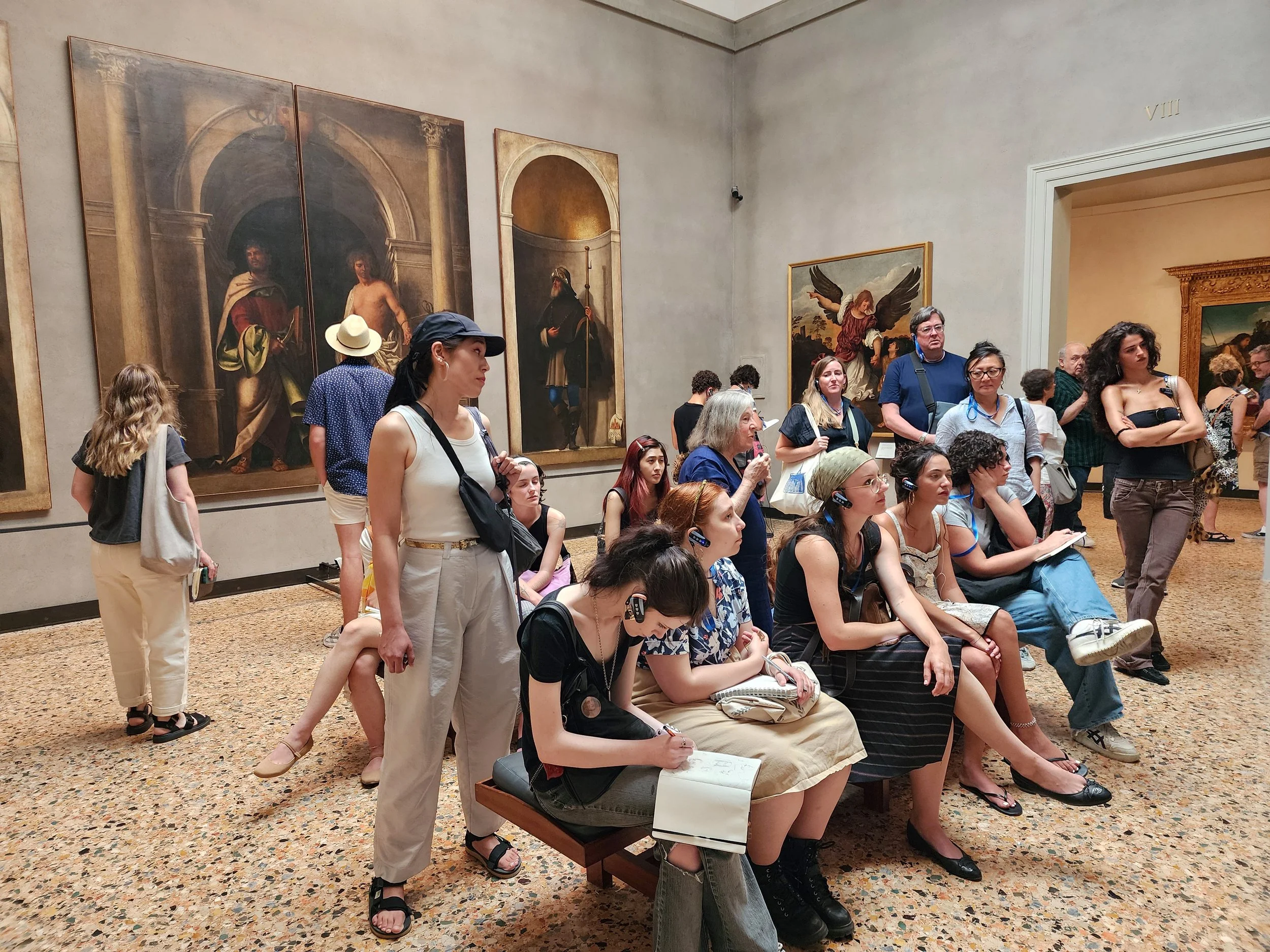
What lines the left loggia wall of Paolo Veronese’s vibrant painting, The Feast in the House of Levi? It was a question I asked in my Venetian Renaissance course, addressed by neither the best online reproductions nor scholarly literature. But standing in front of the massive banquet scene in the Gallerie dell’Accademia, Venice, I found my answer. This was only a sliver of the Pratt in Venice (PiV) summer study program under the direction of the engaging Professor Gisolfi.
I am a dual-degree graduate student in Art History and Library & Information Science. Every day, Venice revealed a new layer to my studies, from the pink-and-white masonry of the Palazzo Ducale to the Indonesian Biennale pavilion at historic Scuola di Grafica. I had visited Italy as an art historian previously, but with only fleeting hours in Venice. This was my first time learning about the Orsoni mosaic factory, the Scuola Dalmata—with a behind-the-scenes look at conservation—and church frescoes less considered. Day trips to Padova (with a private viewing of the Scrovegni Chapel, no less!) and Palladian villas at the foothills of the Alps were program highlights; these provided a vivid understanding of the broader Veneto region.
Examining art and architecture in situ enriched my education, while my research allowed me to explore transcultural connections beyond the borders of Venice. As a PiV graduate assistant, I was also able to support fellow student research at the Cini Foundation and Querini Stampalia libraries, as well as visit the storied Biblioteca Marciana.
Outside of class, a trip to the stunning antiquities chamber of the Palazzo Grimani, working with the city to save a duck trapped in a defunct pasta factory(!), and gorging on lip-smacking cicchetti and gelati made for a summer without equal.
So what was tucked along the left loggia in Veronese’s painting? It was a festive display of vertically stacked plates—a rhythmic, glimmering wall that dazzled the banquet guests and functioned as a (secularized) echo of Christ’s radiance.
Noa Alonso, BFA Art History
For many artists and art historians, visiting Venice is a lifelong dream. Spending six weeks,
living and studying there, turned that dream into a reality. While Venice is often seen as a quick
weekend trip or a stop on the way to another city, it is a place that reveals itself slowly. Living
there allowed me to experience much of what this dynamic city has to offer and notice things
that are easy to miss as a tourist. The program was truly a once-in-a-lifetime experience. I
encountered works of art that had been on my wish list for years, works of art I never imagined I
would see in person, let alone in their original architectural and historical contexts.
What makes Pratt in Venice truly unique is that you do not simply study works of art; you learn
how they were made. Beyond understanding the historical and cultural significance, you gain a
deeper appreciation for the materials, techniques, and craftsmanship behind them. One of the
highlights of the program was going behind the scenes at active conservation sites, visiting the
mosaic conservation labs at San Marco, watching paintings being actively restored, seeing the
traditional materials and methods still in use today, and meeting the conservators and artisans
dedicated to preserving Venice's artistic heritage. These hands-on experiences provide an
understanding of art and conservation that simply cannot be replicated in a traditional
classroom.
The program also extends far beyond Venice itself. I highly recommend taking advantage of
both the organized excursions and the independent trips, as they became some of my favorite
memories of the summer. Visiting the mosaics of Ravenna, the frescoes of Padua, and
spending a weekend in Florence allowed me to experience some of Italy's greatest artistic
treasures while gaining a broader appreciation for its history and culture. One of my favorite
trips was a day trip through the Veneto. We visited Castelfranco Veneto, toured Palladian villas
featuring frescoes by Giovanni Battista Zelotti and Paolo Veronese, drove past the Dolomites,
and ended the day with an unforgettable meal at a local family's home. Experiences like these
deepened my appreciation for Italian culture and created memories I’ll always look back on.
Among Pratt's many study abroad opportunities, Pratt in Venice stands out because it combines
rigorous academics with experiences that very few students would ever have the chance to
have. The faculty – Diana Gisolfi, Elizabeth Duttemen, Fay Ku, Michael Brennan, and Jill
Brandwein – are not only incredibly knowledgeable but also genuinely invested in their students.
They made every lecture, site visit, and discussion engaging, and the relationships I built with
both the professors and my classmates became the most valuable parts of the program. I
wholeheartedly recommend Pratt in Venice to anyone interested in studying abroad. It is an
immersive, challenging, and incredibly rewarding experience that will stay with you long
after the program ends.
